
The company attributes the delay to the slump in demand for commercial vehicles in the country since the beginning of the current year.
Car companies are hoping to buck the slowdown by launching new models to push sales from January. Industry majors like Maruti Suzuki, Mahindra & Mahindra, Hyundai India have all lined up launches in the next few weeks and months hoping to generate reasonable volumes.
The move comes close on the heels of growth in developed auto markets such as the US and Europe dipping in the red. Analysts say that global auto companies are now focusing on developing new models for emerging markets like India, their with main focus on containing costs. The cost of development in India is considered to be the lowest in the world.
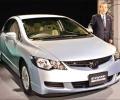
The special discount of Rs 800,000 offered on the Honda Civic Hybrid is not sustainable by the car-maker and could be a strategy to clean up its inventory.
Auto component companies -- especially the mid-size and small ones -- are facing an uphill task to stay afloat as banks have become tight-fisted in giving credit and vehicle makers are cutting orders to combat the slowdown in sales.
The company is evaluating options to launch the Scorpio, Bolero, Xylo and pickup trucks in the Chinese market. However, no firm decision has yet been taken. In China, the company already has a presence in the tractor segment through Mahindra China Tractors, a joint venture company with and Jiangling Motors Company.
Second-hand car prices have dropped 15 to 25 per cent following the imposition of stringent Supreme Court norms over repossessing and selling cars of owners defaulting on their loans.
Auto majors have introduced a range of petrol engines for compact cars that comply with the Euro-V norms and are meant for the export markets. This enables them to prepare for the stringent emission norms to be introduced in the country. While the latest compact cars manufactured in India are Euro-V compliant, the latest petrol car engines are highly fuel efficient.
Mahindra & Mahindra has decided to curtail its capital expenditure of Rs 5,000 crore (Rs 50 billion) in view of the ongoing slump in demand for cars and sports utility vehicles in the domestic market.
India's biggest utility vehicle player Mahindra & Mahindra will spend close to Rs 300 crore ($60 million) towards brand-building and promotion as it prepares to launch its vehicles in the largest automotive market in the world - the United States.
Import duty on steel is a critical factor determining domestic steel prices. Auto component makers and automobile majors, faced with sagging sales over the last two quarters, have expressed strong reservations against the steel industry's demand for re-imposition of 5 per cent import duty on non-alloy steel (used to manufacture car bodies and stamped auto parts).
JLR sees job cut if the situation does not improve.
Most top car makers are offering discounts, targeted specifically at government employees. About 5 million employees are expected to benefit from the government's move to raise its employees' salary by 70 per cent. The revised pay scales will be effective January 2006, which means they will get their pending salaries in bulk. Auto makers are hoping they will use the lumpsum payment to make a down payment for a car.
The company, which is now moving from being a premium brand to a mass market player through two launches in the small car segment in the next four years, hopes to cash in on Brand Honda's strong presence in the rural and semi-urban markets in India. Experts call it a gradual scaling up of the brand in the minds of the Indian consumers -- a strategy followed by the Japanese major in all parts of the globe.
The company already sells medium-to-high powered tractors in the US market. Although the exact date of launching the vehicles in the US was not revealed, company sources said that the launch will take place in January.
The Swift DZire, which is essentially a replacement model for the Esteem, was launched by Maruti Suzuki to strengthen its dwindling position at the entry-level of the sedan segment. The car was launched with an attractive price tag of Rs 4,49,000 in March, 2008.
The rupee's slide against the dollar and euro has put pressure on international automobile companies as compressed margins may force them to revisit prices of imported models in the next few months.
Manufacturers view the agreement - when it is signed - as a defence against the slowdown in the car market.
Tax concessions in Uttarakhand are encouraging auto majors from Hero Honda to Tata Motors to shift a larger part of their manufacturing to the state to counter rising raw material costs and increase their flexibility to offer consumers cheaper models in a competitive market.
Austrian two-wheeler maker KTM Power Sports is developing three intra-city transportation models - a trike, a budget car and a scooter - in a joint collaboration with Bajaj Auto. Bajaj, India's second-largest motorcycle maker, owns 21 per cent stake in KTM.
